Use AI Planners to Reduce Anxiety With Calm-First Routines

Calm by Design: A Practical Way to Use AI Planners to Reduce Anxiety
Anxiety often spikes when tasks feel endless, priorities keep shifting, and the brain tries to hold everything at once. AI planners can help by turning vague worries into clear next steps, reducing decision fatigue, and building a predictable rhythm for days that feel overwhelming. This guide breaks down a calm-first planning approach, with simple routines and guardrails so the planner supports mental space instead of adding pressure.
It can also help to understand what stress does in the body and why “too much at once” feels so intense. For a quick, trustworthy overview, see the American Psychological Association’s guide on stress effects and NIMH’s overview of anxiety disorders.
Why planning can lower anxiety (and when it can backfire)
Anxiety tends to rise with uncertainty, unclear priorities, and too many open loops. A calm plan reduces those loops by creating a short list of “next actions” you can actually complete today—so your mind doesn’t have to keep rehearsing everything you might forget.
Decision fatigue is another driver. When you have to repeatedly decide what to do next, even tiny choices can feel heavy. An AI planner can suggest reasonable options (based on deadlines, effort, and time available) so you’re not re-litigating the same decisions all day.
Planning can backfire, though. Over-planning, rigid minute-by-minute schedules, and constant re-optimizing can increase pressure—especially if you interpret a missed block as “failure.” The goal is “good enough” structure: predictable, flexible, and supportive.
A calm-first plan prioritizes buffer time and recovery blocks over maximum productivity. It aims for a day that feels survivable and steady, not perfect.
What an AI planner should do to support calm
The most calming systems share five jobs: capture, clarify, prioritize, schedule gently, and review. When these are consistent, your brain learns it doesn’t have to hold everything at once.
Calm-first planner features and what to look for
| Need | Helpful AI capability | Calm benefit | Simple test |
|---|---|---|---|
| Too many thoughts | Fast capture + categorization | Less mental load from open loops | Can it turn a brain dump into grouped themes in under 60 seconds? |
| Overwhelm about starting | Task decomposition | Lower activation energy | Does it create a 5-minute first step automatically? |
| Indecision | Priority suggestions with constraints | Fewer repeated choices | Can it rank tasks using time, energy level, and deadlines? |
| Time anxiety | Realistic time estimates + buffers | Fewer schedule surprises | Does it add buffer time without being asked? |
| Burnout cycles | Rest and recovery prompts | Prevents all-or-nothing planning | Will it schedule breaks and low-energy alternatives? |
A calm-first setup: the 4 lists that keep life manageable
Instead of one massive to-do list, use four small lists. This prevents everything from competing for attention at the same intensity.
- Inbox list: one place to dump anything stressful, unfinished, or nagging.
- Today list: 1–3 priorities plus essential maintenance tasks (keep it intentionally small).
- Waiting-on list: anything dependent on other people (responses, deliveries, approvals).
- Someday/optional list: good ideas that are not required right now—so you can release guilt without losing the idea.
Daily routine: a 12-minute reset that prevents spirals
Consistency calms the nervous system. This short reset is meant to be repeatable on your worst days, not just your best ones.
- 2 minutes: brain dump into the inbox (no sorting, no judgment).
- 3 minutes: have the planner convert inbox items into next actions with clear “done” definitions.
- 3 minutes: choose 1–3 priorities based on constraints (energy level, appointments, deadlines).
- 2 minutes: add buffers (travel, transition time, recovery time).
- 2 minutes: prepare a low-energy fallback plan for anxious moments (one tiny task + one self-care action).
Prompts that turn anxiety into clarity
When anxiety is high, the brain tends to speak in vague alarms (“Everything is behind”). The fastest relief often comes from translating that alarm into a concrete, bounded step.
- “Turn these worries into next actions that take 5–20 minutes each, and label each as: urgent, important, or optional.”
- “Given I have low energy today and two hours total, pick the best 3 tasks and schedule them with 15-minute buffers.”
- “Rewrite this project into a checklist with a clear first step I can do in 5 minutes.”
- “Identify what I’m avoiding and propose a gentler version of the task.”
- “Create two plans: Plan A (normal day) and Plan B (anxious day) with fewer steps.”
Boundaries that keep the planner from becoming another source of stress
A ready-to-use guide and checklist for stress-free living
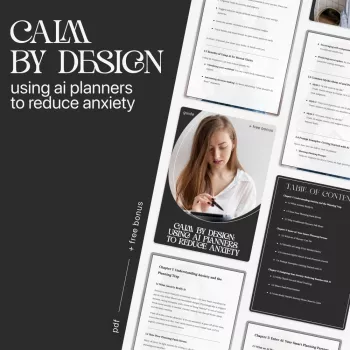
If you want a step-by-step system without piecing it together yourself, Calm by Design: Using AI Planners to Reduce Anxiety – The Ultimate AI Planner to Reduce Anxiety Guide, eBook & Checklist for Stress-Free Living is built around calm-first planning: capture, prioritization, gentle time-blocking with buffers, and quick review rituals that prevent overwhelm from creeping back in.
- Budgeting Like a Pro: Complete eBook – Personal Finance Planner (money clarity can reduce background stress).
- Conflict-Resolution Workbook for Couples | Printable Relationship Communication eBook (fewer unresolved conversations = fewer open loops).
Weekly review: the calm maintenance ritual
FAQ
Can AI planning actually reduce anxiety?
It can help by offloading tasks from your mind into a trusted system, clarifying next actions, and reducing decision fatigue. It’s a support tool, not a replacement for professional mental health care.
What if a planner makes anxiety worse because it feels too strict?
Switch to flexible time windows (morning/afternoon/evening), shrink daily priorities, and add buffer blocks plus a “Plan B” low-energy schedule. Limiting re-planning to one short window per day also reduces pressure.
What’s the simplest way to start if everything feels overwhelming?
Start with one inbox list, choose one 5-minute next step, schedule one buffer block, and do a 3-minute shutdown at night to park loose ends. Keeping the system tiny makes it easier to trust and repeat.










Leave a comment