Mental Clarity Habits: Reset, Focus, Reflect Daily

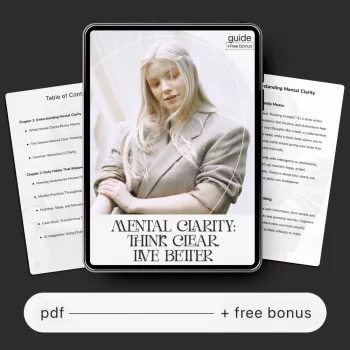
Mental Clarity: Think Clear, Live Better
Mental clarity is the steady ability to focus, prioritize, and respond with intention—even when life feels noisy. A practical approach combines small mindset shifts, attention habits, and simple mindfulness routines that reduce mental clutter. The goal isn’t a perfectly quiet mind, but a reliably workable one: clearer thinking, better decisions, and more consistent follow-through.
What mental clarity looks like day to day
Clear thinking often shows up in ordinary moments: getting started without a long “warm-up,” finishing what matters, and feeling less mentally scattered. When clarity improves, attention steadies and tasks feel more manageable because the brain isn’t constantly re-orienting.
- Attention feels steadier: fewer “tabs open” in the mind and less jumping between tasks.
- Decisions become simpler: priorities are visible and trade-offs are easier to accept.
- Emotional reactivity decreases: a brief pause appears between trigger and response.
- Memory and comprehension improve when distractions are reduced and rest is protected.
- Clarity is a skill set, not a personality trait—built through repeated, small practices.
Research and clinical guidance also point to the role of mindfulness and stress regulation in supporting attention and memory. For example, Harvard Health Publishing discusses how mindfulness practice may support memory and cognitive functioning (source).
Common sources of mental fog (and what they do to focus)
Mental fog is rarely a single problem; it’s usually a stack of small drains. The common thread is cognitive bandwidth—when too much is competing for attention, thinking slows down and the easiest tasks start to look “hard.”
- Information overload: constant updates fragment attention and make tasks feel heavier than they are.
- Context switching: frequent toggling increases errors and makes the brain feel “tired” faster.
- Unfinished commitments: open loops (messages, chores, decisions) quietly drain cognitive bandwidth.
- Stress and poor sleep: reduced recovery amplifies irritability and lowers working memory.
- Environmental friction: cluttered spaces, noisy notifications, and unclear task lists create unnecessary decision fatigue.
Mental fog triggers and quick counter-moves
| Trigger | What it causes | Quick counter-move |
|---|---|---|
| Too many notifications | Shallow attention and constant checking | Turn on Focus/Do Not Disturb for 60–90 minutes |
| Too many tasks at once | Overwhelm and procrastination | Pick 1 “next action” and write it as a verb |
| Unclear priorities | Busywork replaces progress | Choose 3 outcomes for today (not 12 tasks) |
| Messy workspace | Visual distraction and avoidance | 2-minute reset: clear only the working area |
| Low sleep quality | Slower thinking and mood swings | Set a consistent wind-down cue and screen cutoff |
Stress can intensify mental fog by keeping the body in a higher-alert state, which makes calm, deliberate thinking harder to access. The American Psychological Association outlines how stress affects the body and mental functioning (source).
A simple daily framework: reset, focus, reflect
Clarity improves when there’s a repeatable structure that reduces decision fatigue. A useful rhythm is: reset your state, focus on one meaningful target, then reflect to close loops and set up tomorrow.
- Reset (2–5 minutes): breathe slowly, relax shoulders/jaw, and name the current emotion without judging it.
- Focus (25–45 minutes): work in one window, one goal, one timer; keep a “parking lot” note for distracting thoughts.
- Reflect (3 minutes): capture what was learned, what’s next, and what can be removed or delegated.
- Use cues to make it automatic: same time, same place, same first step (open guide, start timer, begin).
- Aim for consistency over intensity; short, repeatable routines beat occasional long sessions.
One practical way to make this easier is to keep the “reset” and “reflect” steps short on purpose. When the routine feels lightweight, it’s more likely to happen even on busy days.
Mindfulness practices that support clear thinking
Mindfulness isn’t about forcing the mind to be empty. It’s about noticing what’s happening sooner—so attention can be redirected before a spiral turns into a lost hour.
Build an environment that makes focus easier
Sleep is also a foundation for clearer thinking. If attention feels unusually fragile, consider whether sleep duration and consistency have shifted; the National Sleep Foundation provides general guidance on sleep needs by age (source).
Using a printable guide to turn insight into a repeatable habit
- A structured digital guide helps convert vague goals into daily steps and prompts.
- Printable pages support consistency: check-ins, reflection prompts, and simple tracking reduce mental load.
- Look for exercises that balance focus skills (attention, prioritization) with mindfulness skills (awareness, emotional regulation).
- A good system includes both “in the moment” tools (calming and refocusing) and “between moments” tools (planning and decluttering).
- Recommended option: Mental Clarity: Think Clear, Live Better | Digital Guide for Focus and Mindfulness for a focused, printable approach to building clarity over time.
Clarity often improves when other life systems feel less chaotic, too. If finances or relationship stress are taking up mental real estate, supportive tools can help reduce background noise—such as Budgeting Like a Pro: Complete eBook – Personal Finance Planner or the Conflict-Resolution Workbook for Couples.
When clarity is harder than usual
FAQ
How long does it take to build better mental clarity?
Small improvements can show up in a few days when sleep and distractions are addressed. More stable, “reliable” clarity usually builds over several weeks of consistent routines, especially when reflection helps you adjust what isn’t working.
What is the fastest way to refocus when the mind feels scattered?
Take five slow exhales, write the next action as a single sentence, and set a 25-minute timer. Keep a quick “parking lot” note nearby so distracting thoughts can be captured without stealing your attention.
Do printable mindfulness exercises actually help with focus?
They can, because prompts reduce decision fatigue and make practice more consistent. Results tend to be better when the exercises are short and used daily, so progress becomes visible and repeatable.











Leave a comment