Stay Calm When Plans Change: 60-Second Reset Tools

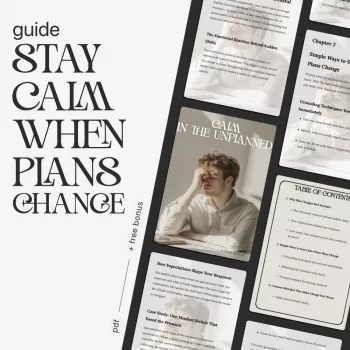
Calm in the Unplanned: Mindfulness and Resilience When Plans Change
Last-minute changes can spike stress fast—missed trains, canceled meetings, unexpected bills, or a child getting sick. Calm isn’t about pretending it’s fine; it’s the skill of steadying the body, widening options, and choosing the next helpful step. Below are practical, repeatable tools for staying grounded when the day goes off-script, plus simple ways to build resilience so surprises don’t hit as hard.
Why plan changes feel so intense
Even small disruptions can feel huge because uncertainty often registers as a potential threat. When the brain can’t predict what happens next, it may flip into fight-or-flight—faster heart rate, narrowed attention, and a strong urge to “fix it now.”
- Stress shows up in the body first: tight chest, shallow breathing, clenched jaw, racing thoughts, irritability, or urgency.
- A sudden change can feel like lost control: the goal isn’t total control; it’s rebuilding agency with small, concrete choices.
- Secondary stressors add fuel: self-criticism (“I should’ve planned better”), catastrophizing, and time pressure can make the original problem feel twice as big.
For a quick overview of how stress affects the mind and body—and why regulation helps—see the American Psychological Association’s stress resources.
A quick reset in under 60 seconds
When plans change, the fastest path to clarity is usually through the nervous system. Try this short “reset loop” before you problem-solve.
- Name the moment: silently label it: “Change of plan.” A label can reduce emotional flooding and help you shift from reaction to observation.
- Lengthen the exhale: take 3–5 breaths with a longer exhale (example: inhale 4, exhale 6). This cues safety and helps soften panic.
- Release tension points: unclench your jaw, drop your shoulders, and let your tongue rest away from the roof of your mouth.
- Choose one stable anchor: feel your feet on the floor, notice clothing against your skin, or pick one sound in the room.
- Ask one stabilizing question: “What is the next smallest step that helps?”
Mindfulness skills for unpredictable moments
Mindfulness is less about “clearing the mind” and more about noticing what’s happening without getting dragged by it. If you’re new to the concept, the NHS guide to mindfulness is a practical, approachable reference.
Use RAIN to move through strong feelings
- Recognize: “This is frustration.” “This is anxiety.”
- Allow: stop arguing with the feeling. Let it be present for a moment without adding a second fight.
- Investigate: where is it in the body—throat, belly, chest, face? Is it sharp, heavy, buzzing, hot?
- Nurture: offer a supportive phrase: “This is hard, and I can handle the next step.”
Ground the senses to interrupt spiraling
Try the 5–4–3–2–1 scan: identify 5 things you see, 4 you feel, 3 you hear, 2 you smell, and 1 you taste. It’s simple, discreet, and often enough to break the loop.
Defuse from thoughts instead of obeying them
When the mind starts predicting disasters, add a short prefix: “I’m having the thought that…” This shifts thoughts from commands to mental events—useful information, not absolute truth.
Micro-mindfulness while moving
If you can’t sit and breathe, build calm while doing something normal: feel each step for 10 seconds while walking, or wash your hands slowly and track temperature and sensation. When emotions surge, widen attention to include your whole body and the room, not just the problem.
For a science-based overview of mindfulness and safety considerations, review the NCCIH summary on meditation and mindfulness.
Resilience moves: from reaction to response
Choose the right tool for the moment
| Situation | What to do in 30–90 seconds | What it helps with |
|---|---|---|
| Plans change unexpectedly | 3 long exhales + label the moment (“Change of plan”) | Reduces panic and urgency |
| You feel overwhelmed | 5–4–3–2–1 grounding scan | Interrupts spiraling thoughts |
| Anger rises in a conversation | Pause, relax jaw/shoulders, reflect one sentence back | Prevents escalation and defensiveness |
| Decision pressure | Facts vs. story + pick the next smallest step | Restores clarity and agency |
| You made a mistake | Self-compassion phrase + one repair action | Cuts shame and speeds recovery |
Build a “calm baseline” so surprises hit softer
A guided approach for staying steady when plans change
If you want tools designed specifically for unexpected changes, consider Calm in the Unplanned | Mindfulness & Resilience Guide for Stressful Situations | Ways to Stay Calm When Plans Change.
If plan changes tend to spark arguments or defensiveness, a communication framework can help you stay connected while you problem-solve. The Conflict-Resolution Workbook for Couples | Printable Relationship Communication eBook | Improve Listening, Resolve Arguments, Rebuild Trust focuses on listening, repair, and next-step agreements.
And when the disruption is financial—surprise expenses, shifting income, or new priorities—having a clear system can reduce the “urgent scramble.” Budgeting Like a Pro: Complete eBook – Personal Finance Planner, Zero-Based Budgeting, 50/30/20, Pay-Yourself-First, Debt Payoff & Savings Plan supports quick recalibration when the numbers change.
FAQ
How can calm happen quickly when something goes wrong?
Start with the body: take a few longer-exhale breaths, relax your shoulders and jaw, and name the moment (“Change of plan”). Once your nervous system settles even a notch, pick one small next step instead of trying to solve everything at once.
What if mindfulness makes feelings feel stronger at first?
That can happen when you stop avoiding sensations and finally notice them. Keep practices shorter, try eyes open, anchor to external sounds or your feet on the floor, and return to problem-solving after a brief reset.
How do you stay calm when plans change because of other people?
Separate facts from story, pause before replying, and make a clear request or boundary. If conflict starts, reflect back what you heard and propose one concrete next step rather than debating intentions.











Leave a comment