Digital Work-Life Balance Plan to Prevent Burnout

Modern work and wellness: a practical digital balance plan that holds up on busy weeks
Work doesn’t end when the laptop closes anymore—messages can land at dinner, notifications can interrupt recovery, and “just one more task” can quietly steal sleep. A sustainable routine needs more than motivation; it needs boundaries you can repeat, a few small habits that calm the body fast, and a simple way to spot rising stress before it turns into burnout. (The World Health Organization recognizes burn-out as an occupational phenomenon, shaped by chronic workplace stress that hasn’t been successfully managed.)
What “balance” looks like in a connected workday
Balance isn’t a perfect split between work and life. In a digital workday, it’s a set of repeatable guardrails that protect your energy while keeping performance steady.
- Balance as boundaries: clear start/stop times, notification rules, and recovery blocks you treat like meetings.
- Wellness as capacity-building: sleep, movement, nutrition, mental reset, and social connection that support output—especially during demanding periods.
- A realistic target: fewer high-stress hours per week, more predictable energy, and faster recovery after intense sprints.
- Common friction points: always-on messaging, meeting overload, multitasking, and blurred home/work spaces.
Spot the stress pattern before it becomes burnout
Burnout rarely arrives overnight. It builds when warning signs are ignored, recovery gets postponed, and the nervous system stays “on” for too long. If you notice symptoms sticking around for two weeks or more, treat it as a signal to reduce load and increase recovery immediately.
- Early indicators: irritability, poor sleep, frequent headaches, reduced focus, procrastination, and emotional numbness.
- Work triggers to note: unclear priorities, constant context-switching, lack of autonomy, and high-stakes deadlines with no recovery time.
- Body signals to track daily: sleep quality, muscle tension, appetite changes, and an afternoon energy drop.
Quick stress check-in (daily, 2 minutes)
| Signal | 0–10 rating | What changed today? | One small fix (today) |
|---|---|---|---|
| Sleep quality | |||
| Mental load | |||
| Body tension | |||
| Mood/irritability | |||
| Energy after lunch |
Keep the check-in lightweight. The goal is pattern recognition—what consistently spikes stress, and what reliably brings it down. For evidence-based basics on stress and its effects, the National Institute of Mental Health provides a useful overview: 5 Things You Should Know About Stress (NIMH).
Build a weekly structure that protects focus and recovery
Instead of trying to “fit in wellness,” design your week so focus and recovery are built into the default plan.
- Design the week first: assign 2–4 focus blocks, 1–2 admin blocks, and 2 recovery anchors per day (even 5–15 minutes counts).
- Time-block priorities: choose the top 1–3 outcomes per day and protect them from meetings where possible.
- Create end caps: a 5-minute start ritual and a 10-minute shutdown ritual to reduce after-hours rumination.
- Use a workload ceiling: define a maximum number of meetings or deep-work hours to avoid chronic overload.
A practical example: schedule two 90-minute deep-work blocks on Monday/Wednesday, batch admin on Tuesday/Thursday, and place recovery anchors right after meetings (walk, stretch, snack, hydration). Consistency beats intensity.
Digital boundaries that actually stick
Digital boundaries work when they’re specific, visible, and slightly inconvenient to break.
Sleep is a cornerstone boundary. If after-hours screen time is cutting into rest, start by protecting the last 30–60 minutes before bed. For sleep guidance and why it matters, see: CDC: Sleep and Sleep Disorders.
Micro-habits for calm, energy, and resilience (no extra hours needed)
Try a guided “if-then” plan for stressful moments
| If… | Then… (2–5 minutes) | Result to look for |
|---|---|---|
| A meeting runs back-to-back | Stand, stretch hips/neck, drink water | Less tension, more focus |
| An email spike triggers anxiety | Write 3 next actions; schedule a response block | Clarity, reduced urgency |
| Afternoon crash hits | 10-minute walk + light snack | Energy rebound |
| Racing thoughts at night | Brain dump + choose 1 first task for tomorrow | Faster sleep onset |
A simple planner system: measure what matters and adjust weekly
Use a guided workbook when consistency is the hardest part
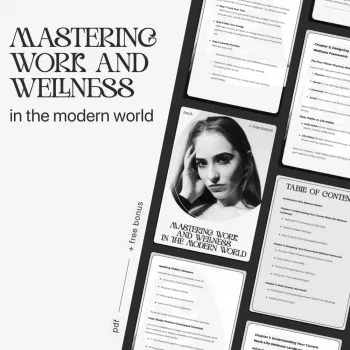
If you want a ready-made framework, Mastering Work and Wellness in the Modern World (eBook and stress management planner) organizes digital boundaries, quick check-ins, and weekly planning in one place. Two related supports that can reduce background stress outside of work are Budgeting Like a Pro: Complete eBook (planner approach for financial stress) and the Conflict-Resolution Workbook for Couples (communication tools that reduce stress at home).
For a concise definition of burnout and how it’s discussed globally, see: World Health Organization: Burn-out an “occupational phenomenon”.
FAQ
How many hours should be set aside for wellness each week to see a difference?
Consistent small blocks add up: 10–30 minutes a day plus protected sleep is enough to shift energy and stress over a few weeks. During deadlines, use a minimum plan (sleep, hydration, and a short movement block) and scale up on lighter weeks.
What are practical ways to stop checking email and messages after work?
Turn off non-critical notifications, remove email from the home screen, and set scheduled response windows so you’re not reacting all evening. Pair that with a shutdown ritual and keep the phone out of the bedroom to reduce late-night checking.
What should be tracked to manage stress without overcomplicating it?
Track 3–5 simple metrics: sleep quality, daily stress rating, energy (especially after lunch), deep-work hours, and one recovery habit like movement. Do a 15-minute weekly review and change only one boundary at a time for steady improvement.











Leave a comment